

WooCommerce Demand Analytics: How to Use Waitlist Data to Forecast Stock & Pricing
Oct
Table of Contents
Introduction
Here’s why you need advance WooCommerce Demand Analytics.
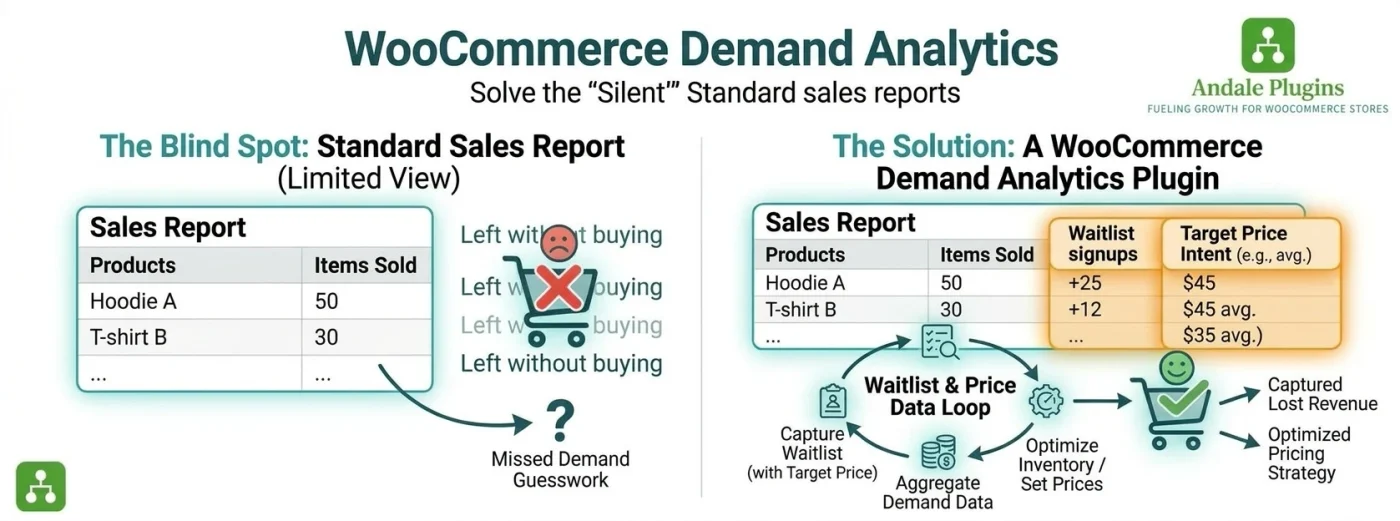
Every e-commerce store relies on sales reports to judge performance. You look at revenue, unit volume, and top-selling products to determine what to reorder and when. But standard sales reports have a massive blind spot: they only reveal what you already sold, completely ignoring the revenue you lost because an item was out of stock or priced just out of reach.
When high-intent shoppers visit a store and find a product unavailable or slightly above their budget, they leave without generating a single transaction record in standard reporting. Without leveraging WooCommerce demand analytics to track that unfulfilled interest, merchants are forced to guess supplier order quantities, risk overstocking slow-moving products (including variants when applicable), or leave proven demand uncaptured.
This is where turning subscriber waitlist data into actionable intelligence changes the equation. By capturing granular waitlist volume and target price intent directly on your product pages, you transform silent bounced traffic into predictive store telemetry. In this guide, we’ll explore how to turn subscriber intelligence into smarter inventory forecasting, risk-free price testing, and higher margin retention.
1. The Blind Spot: Guessing Your Inventory and Pricing Needs
Standard WooCommerce reporting is fundamentally reactive. It answers questions about past behavior: How many units sold last month? Which product generated the most revenue?
While historical sales data is valuable for stable catalogs, it breaks down in three critical scenarios:
- Untracked Stockouts: When a popular variation sells out, daily sales drop to zero. Traditional analytics mark this as low sales activity, even if hundreds of potential buyers visited the page while it was unavailable.
- Margin Erosion from Blanket Discounts: When sales slow down, merchants often default to sitewide discounts or broad sales, eroding profit margins across all inventory just to clear a few lagging products.
- Supplier Order Misalignment: Reordering stock based purely on past sales velocity often leads to over-ordering items whose trend has faded or under-ordering products experiencing a sudden surge in search and view intent.
To eliminate this guessing game, store owners need a mechanism that records customer intent at the moment of friction—capturing exactly who wants an item, when they want it, and what price point unlocks their purchase.
2. Turning Subscriber Waitlists into Predictive Demand Analytics
Every time a shopper fills out a back-in-stock alert or sets a target price notification, they are providing explicit, high-intent market data. Aggregating these requests creates a real-time demand ledger for your store.
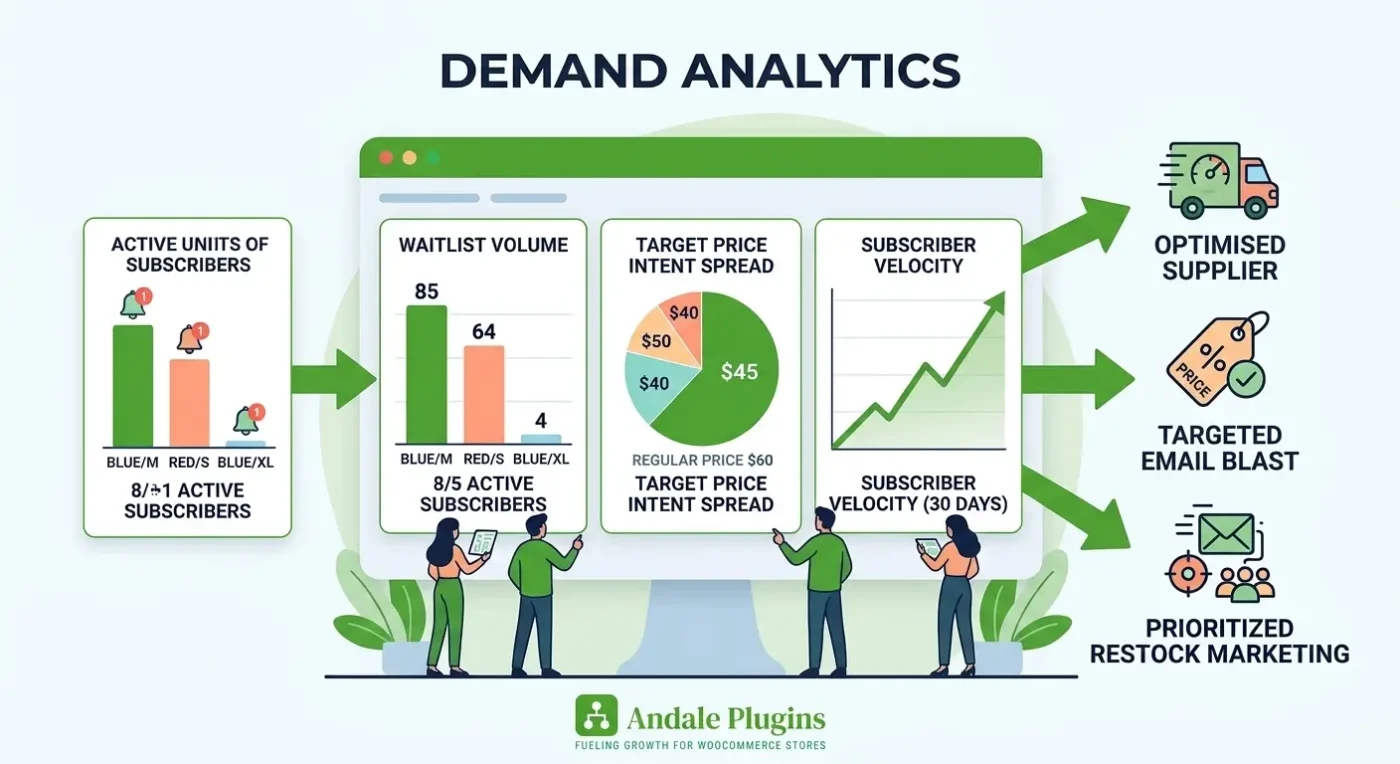
Instead of treating notifications strictly as automated email triggers, viewing them through the lens of WooCommerce demand analytics unlocks three crucial data points:
- Waitlist Volume Per Product (including variants): Seeing exact subscriber counts broken down by product and specific variation (e.g., 85 subscribers waiting for Size M vs. 4 for Size XL) reveals true restock priority before committing capital to supplier purchase orders.
- Target Price Elasticity: Aggregating requested target prices against your regular catalog price establishes the exact price gap required to move inventory without unnecessarily deep discounting.
- Subscriber Velocity: Tracking how fast a product’s waitlist grows over days or weeks provides early indicators of shifting consumer interest, allowing you to reorder before stock completely runs dry.
By centralizing these insights in your admin dashboard, you replace speculation with actionable, data-backed inventory planning.
Standard sales reports tell you what you’ve sold, but only a complete view of unfulfilled intent reveals what you could have sold. The diagram below illustrates how capturing waitlist and target price data fills this critical operational gap:
3. Three Ways to Use Demand Data to Optimize Your Store
With a centralized view of subscriber intent and waitlist telemetry, store owners can move from guessing to executing three high-impact operational strategies:
- Precision Supplier Purchasing: Instead of ordering bulk inventory based on vague historical averages, allocate capital exclusively to products and variants with confirmed active waitlists—grounding your reorders in established demand forecasting methodologies while applying practical inventory forecasting techniques to your store layout. If a specific variation has zero subscribers, skip reordering it entirely.
- Data-Driven Price Testing: Reviewing the delta between your regular prices and submitted target prices provides a clear risk-free indicator of where price sensitivity actually sits. You can evaluate whether a minor promotional adjustment will capture a massive cluster of pending buyers.
- Targeted Restock & Recovery Marketing: When inventory arrives or recovery conditions are met, your subscriber database allows you to prioritize outreach directly to the shoppers who registered interest, ensuring high conversion velocity right out of the gate.
4. Closing the Loop: Linking Analytics to Automated Actions
When setting up your WooCommerce demand analytics system, collecting data is only half the battle; the real value comes from turning insights into automated revenue. In a modern WooCommerce tech stack, analytics shouldn’t require complex external software or bloated third-party scripts.
By managing back-in-stock alerts and target price notifications through Smart Stock Notifications, all demand telemetry is captured natively inside your WordPress dashboard.
- Internal Link Note: To see how these subscriber triggers work on the frontend and backend, explore our guides on automatically notifying WooCommerce customers when out-of-stock products return and capture price-sensitive shoppers with automated recovery offers.
Conclusion: Stop Guessing, Start Capturing Demand
E-commerce success relies on understanding your customers before they walk out the door. By treating back-in-stock subscriptions and target price requests as core metrics rather than mere notification tools, you turn every visitor’s hesitation into valuable operational intelligence.
Leveraging WooCommerce demand analytics ensures your capital goes toward the exact stock your customers are asking for, protecting your margins and scaling your store with absolute precision.
